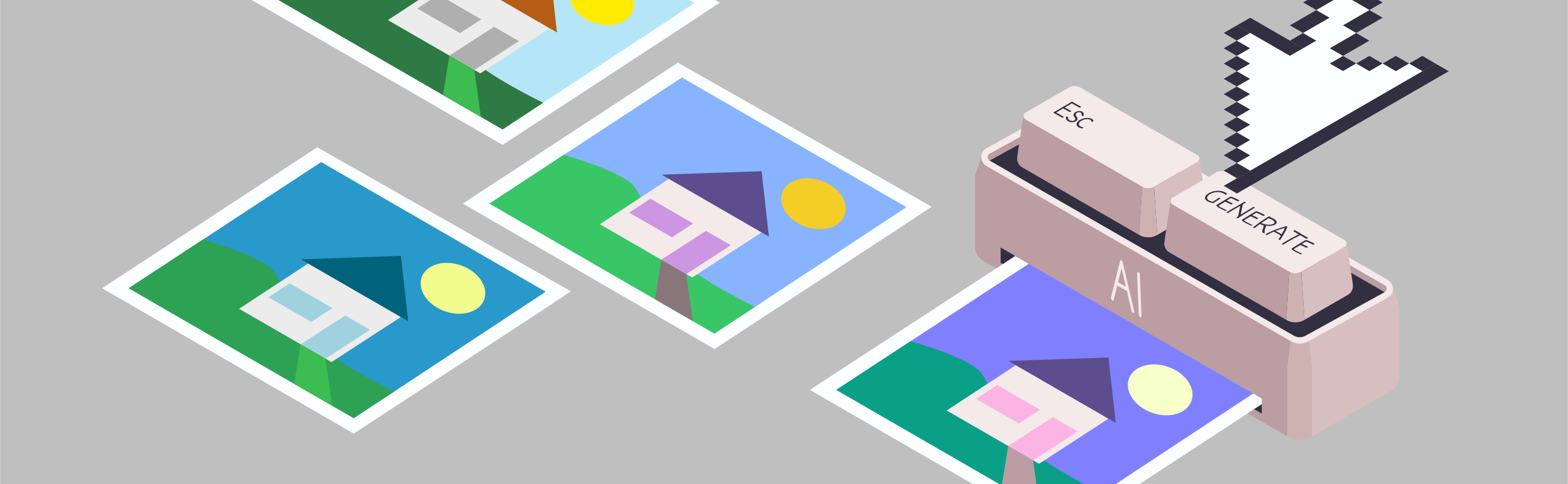
For years, brands approached social media visuals with a conventional formula: produce a polished shoot, refine the assets in post-production, publish, and hope the algorithm reaches the target audience. However, as we have observed this year, that linear approach is no longer sufficient. Social platforms have evolved into ecosystems that reward dynamic attributes such as speed, contextual relevance, experimentation, and continuous adaptation. Traditional production methods simply cannot keep pace with the velocity, scale, and creative agility these platforms now demand.
This shift is far from subtle; brands worldwide are rethinking not only the aesthetic of their content but the fundamental methodology of its production. AI-generated imagery has become highly sophisticated, controllable, and precisely aligned with tangible business objectives. What once required weeks of coordination, budget approvals, and logistics can now be ideated, generated, and refined within hours. This efficiency does not replace creativity; rather, it eliminates the operational friction that historically hindered creative teams.
The real debate is not “AI vs. Humans” or “AI vs. Photography,” but rather whether content should be static and slow, or adaptive and market-responsive. Traditional shoots offer an authentic texture and tangible human presence that AI cannot yet fully replicate, but they are constrained by fixed settings and high costs for every iteration. Conversely, social media demands a constant stream of fresh content. Capturing attention in a sea of thousands of images requires refreshed narratives, localized visuals, and rapid creative iteration. This is where AI serves not as a cheaper replacement, but as a crucial strategic layer, allowing brands to test new approaches instantly and tailor content for specific markets without overhauling entire productions.
For Korean brands expanding globally, this level of customization - adapting model types, climates, and cultural cues - is made feasible and fast through AI. The future of creative production is fluid, and brands that embrace a hybrid model will dominate social media performance. Partnering with a data-driven global social media marketing agency like DISRUPT ensures your brand can compete on the world stage with this advanced creative engine.

What the Data Reveals: AI vs. Traditional Performance in 2025
While the industry debates aesthetics, social media platforms have already provided a definitive answer: AI-generated visuals are outperforming traditional shoots in key metrics like speed-to-market and experimentation volume. The primary advantage is not necessarily that AI "looks better," but that it allows brands to iterate with superior agility.
Today’s algorithms favor content that feels timely and relevant. Traditional production cycles - from ideation and planning to shooting and retouching - can take weeks, a pace that fails to match a world where trends shift within 48 hours. AI-generated content transitions brands from rigid cycles to continuous creative iteration, enabling teams to A/B test multiple concepts simultaneously and generate new variations instantly. This scale of experimentation is what drives higher click-through rates and more accurate targeting.
Recent industry studies consistently indicate that brands leveraging AI to scale creative variations experience significantly less creative fatigue and maintain higher engagement consistency. They also benefit from a better alignment with audience interests, more efficient ad spend, and substantially lower production overhead.
For Korean brands expanding overseas, AI allows for the seamless localization of beauty or lifestyle campaigns - adjusting skin tones, home environments, or fashion sensibilities - without the need for multiple, costly shoots across different countries. It is important to recognize that AI does not replace traditional photography; instead, it fills the critical gaps of speed and volume. The winners in 2025 are not necessarily those with the "prettiest" content, but those producing the most relevant content consistently and rapidly. This evolution requires a partner like DISRUPT, capable of managing high-precision, high-volume creative workflows.
How AI Strengthens Creative Strategy and Improves Global Market Fit
In the current landscape, the value of a visual is determined by its behavior: does it stop the scroll, feel culturally appropriate, and communicate value clearly? AI empowers brands to produce strategic visuals that align with audience intent through four key capabilities.
1. Endless variation for testing
Instead of relying on a single "hero shot," teams can deploy dozens of variations to discover what resonates and build creative systems that evolve based on real-time data.
2. Localization at scale
A Korean skincare brand can instantly adapt its imagery for various global scenarios and models without the logistical burden of shipping products or hiring international crews.
3. Faster creative refresh
When engagement metrics begin to dip, brands no longer need weeks to pivot; they can update their creative direction within the same day.
4. Better control of visual branding
AI workflows allow for precise control over lighting, color, and composition, ensuring brand cohesiveness across vast content libraries more easily than variable real-world shoots.
For Korean brands, this is transformative. International consumers expect tailored content, and AI provides the power to meet these expectations without straining budgets or creative resources. The brands that win are those with the "smartest" images. As competition intensifies, the demand for strategic creative systems will grow, particularly on platforms like Instagram, where a high-performance agency like DISRUPT can amplify these assets with channel-specific precision.
The Future Is Hybrid: Why the Most Successful Brands Will Blend Human Creativity With AI Speed
The most successful brands of the future will not choose between AI and traditional shoots; they will master their integration. AI-generated imagery expands the limits of possibility, but it does not replace the emotional nuance and brand truths delivered by human-led production. This hybrid model solves the ultimate marketing challenge: producing a high volume of content that remains visually consistent, brand-safe, and performance-optimized across global markets.
Traditional shoots establish the emotional resonance and realism of a brand, while AI extends that world by allowing teams to localize and iterate with unprecedented speed. For Korean brands, this balance is essential as global competition and consumer expectations accelerate. Relying solely on traditional production leads to stagnation, while relying solely on AI risks a loss of authenticity.
The competitive edge lies in the blend. However, effectively merging these worlds requires more than just tools; it requires deep expertise. AI is valuable because it enables systems that increase ROAS, reduce creative fatigue, and ensure continuous adaptation. This is where DISRUPT excels as a future-focused global Instagram advertising agency. Our team merges strategic direction with advanced AI workflows to engineer content ecosystems that scale and convert. The future of social media will not be slower, but your creative engine can be smarter and more adaptable. Building that future begins today.